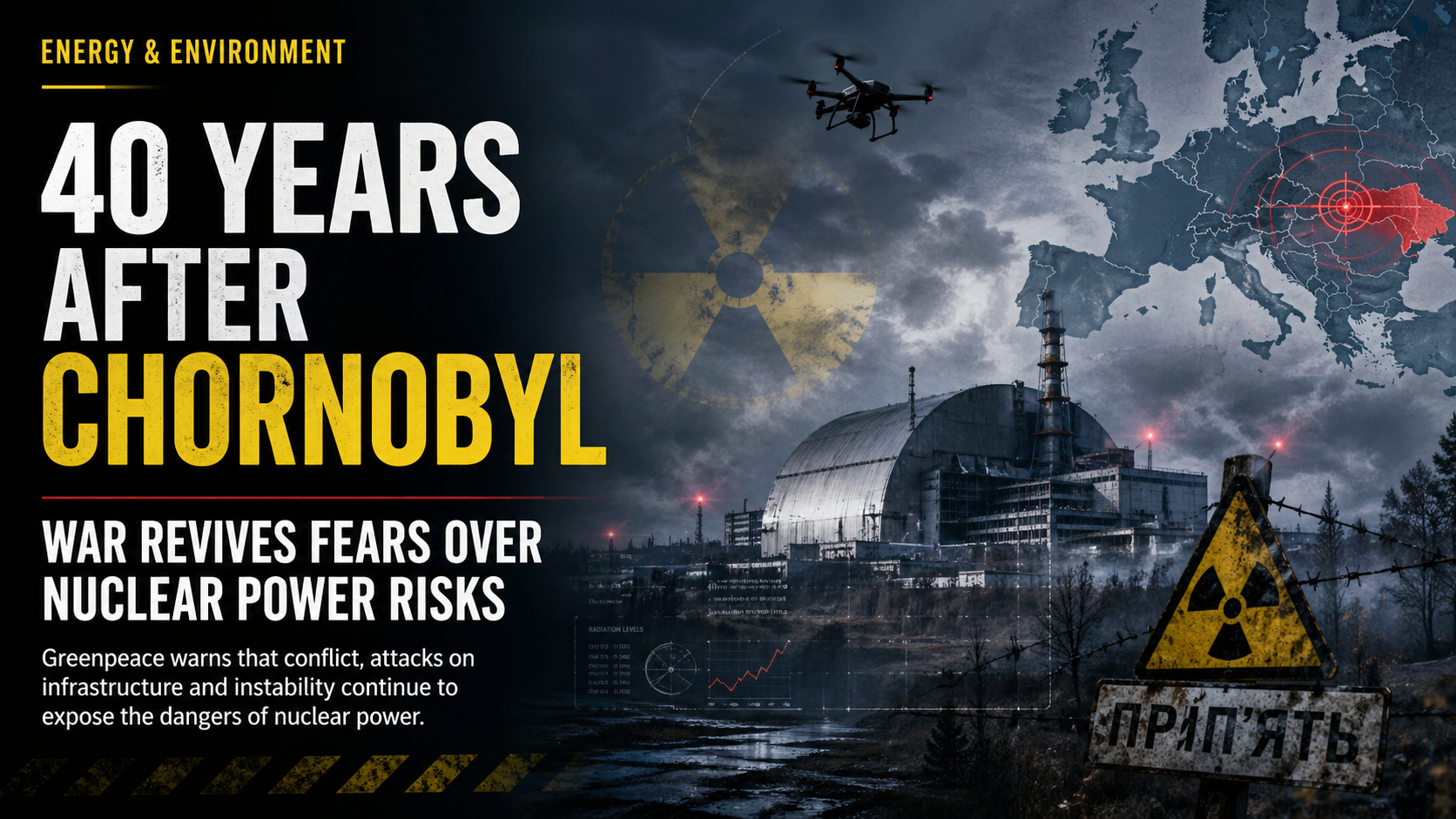
Forty years after the Chornobyl nuclear disaster, concerns over nuclear safety are once again moving to the center of the global energy debate. Greenpeace International has warned that the risks revealed by Chornobyl have not disappeared; instead, they are being reshaped by war, geopolitical tension and increasingly unstable climate conditions.
The warning comes as Ukraine continues to face the consequences of Russia’s full-scale invasion. Greenpeace argues that nuclear power stations operating in or near conflict zones create a dangerous vulnerability, especially when energy infrastructure becomes a military target. According to the organization, the war in Ukraine has shown how large, centralized nuclear facilities can become both a security risk and a political tool.
A key focus of the statement is Chornobyl’s New Safe Confinement, the structure built to contain the damaged reactor unit 4 and its radioactive remains. Greenpeace says a new analysis commissioned by Greenpeace Ukraine found that the structure’s primary functions were severely compromised following a Russian drone strike last year. The organization warns that repairs are now urgent, but the ongoing war continues to threaten efforts to safely manage the site.
Greenpeace also points to a different energy model emerging in Ukraine: decentralized renewable systems. Solar power combined with battery storage has helped hospitals, schools and municipalities continue operating during blackouts. The organization highlights the Green Outpatient Clinic in Horenka, near Kyiv, as one example of how renewable energy can support local resilience during crisis.
The message is clear: Chornobyl is not only a tragedy of the past, but a warning for the present. Greenpeace says governments should prioritize safer, decentralized renewable energy systems that are harder to disable, faster to repair and less vulnerable to conflict.
As the world marks four decades since Chornobyl, the debate over nuclear power is no longer only about energy production. It is also about war, security, public safety and the future of resilient energy systems.